Best places to visit in Leh
Best places to visit in Leh
Leh, the capital of the union territory of Ladakh at an altitude of 3,500 meters, is one of the most dramatic and culturally rich destinations in all of India, situated in a high-altitude desert valley flanked by the Karakoram and Himalayan ranges. The 9th-century Leh Palace overlooking the town, the fluttering prayer flags at Shanti Stupa, and the ancient monasteries of Hemis and Thiksey are landmarks that define this Buddhist heartland. Leh serves as the hub for epic road trips on the Manali-Leh and Srinagar-Leh highways and for organizing expeditions to Pangong Lake, Nubra Valley, and the Zanskar region.

Leh Palace
→Leh Palace is a nine-storey 17th-century royal palace dominating the Leh skyline from a rocky hilltop — built by Ladakhi King Sengge Namgyal and modelled on the Potala Palace in Lhasa. A top Leh sightseeing attraction, it houses royal chapels, ancient thangka paintings, and offers sweeping 360-degree views of Leh town, Stok Kangri, and the Indus Valley. Managed by the Archaeological Survey of India. Entry fee applies. Best visited at sunrise for golden light.

Shanti Stupa
→Shanti Stupa is a gleaming white Buddhist peace pagoda atop Chanspa Hill in Leh, built in 1991 by Japanese Buddhist monk Gyomyo Nakamura to promote world peace. At 4,267 m, it offers the most panoramic sunrise and sunset views of Leh town, the Indus Valley, and the Ladakh and Stok Kangri mountain ranges. One of the most photographed Leh landmarks and a top sunrise viewpoint in Ladakh — a 15-minute uphill walk or short taxi ride from Leh bazaar.

Thiksey Monastery
→Thiksey Monastery is one of Ladakh's most impressive and visited Buddhist gompas — a 12-storey whitewashed complex resembling the Potala Palace, perched above the Indus Valley 19 km from Leh. Home to over 120 monks and a magnificent 15-metre Maitreya Buddha statue, it hosts the spectacular Gustor festival each November. Morning prayers (6 AM) offer an authentic monastic experience. A top Leh-Ladakh tourist attraction on every Manali-Leh and Srinagar-Leh road trip.
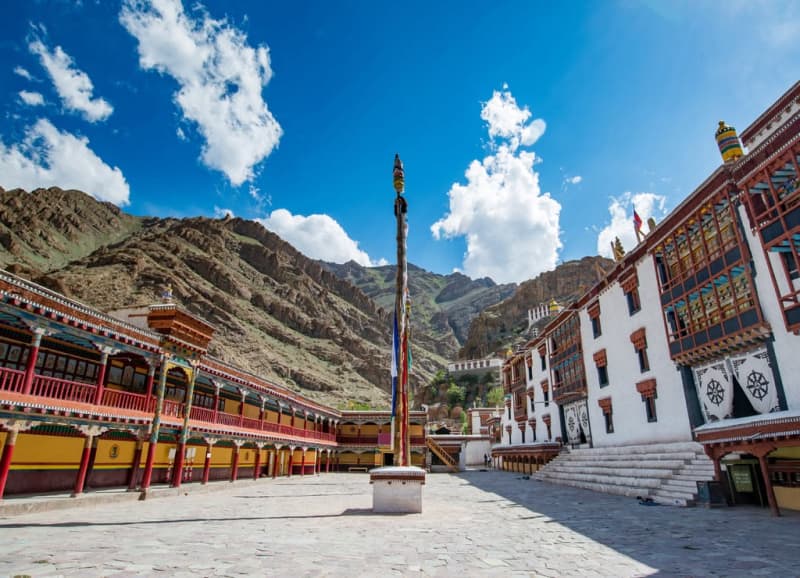
Hemis Monastery
→Hemis Monastery is the largest, wealthiest, and most celebrated Buddhist gompa in Ladakh — a sacred Drukpa Kagyu monastery 45 km from Leh, known worldwide for the grand Hemis Festival each June/July. Featuring one of the finest collections of thangkas and Buddhist relics in the Himalayas, including a massive silk thangka displayed only once every 12 years, it is Ladakh's most important spiritual site and a UNESCO tentative World Heritage nominee. A must-visit on every Ladakh itinerary.

Magnetic Hill
→Magnetic Hill on the Leh-Kargil-Srinagar Highway 30 km from Leh is a famous optical illusion where vehicles appear to roll uphill against gravity — one of Ladakh's most photographed and talked-about roadside curiosities. The Magnetic Hill phenomenon is caused by the surrounding hillside geometry creating a false horizon effect. A beloved stop on every Leh-Ladakh road trip, combined with the nearby Gurudwara Patthar Sahib and the Indus-Zanskar river confluence.

Sangam (Indus-Zanskar Confluence)
→Sangam is the dramatic confluence of the Indus and Zanskar rivers 35 km from Leh — a striking natural spectacle where the turquoise Zanskar meets the grey-green Indus at a sharp angle. One of Ladakh's most iconic landscape photography locations and a top Leh sightseeing attraction. In winter (January–February), the frozen Zanskar River becomes the legendary Chadar Trek route. Rafting and kayaking on the Zanskar in summer are top Ladakh adventure activities.
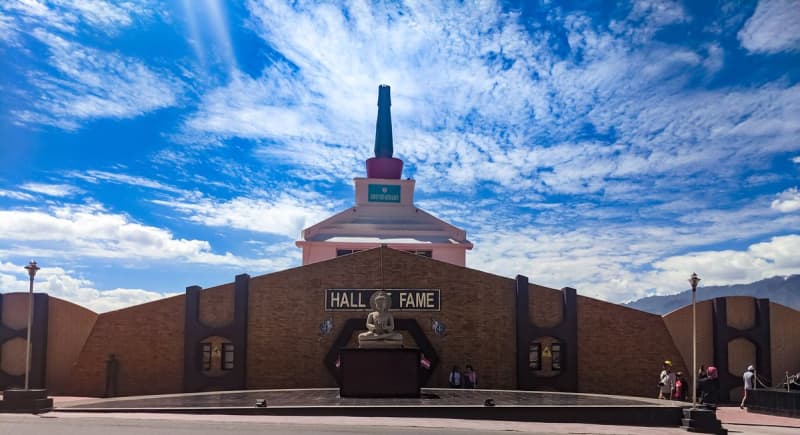
Hall of Fame Museum
→Hall of Fame Museum in Leh is a moving tribute to Indian Army soldiers who laid down their lives defending Ladakh in the 1947, 1965, and 1999 Kargil wars. Managed by the Indian Army, it houses weapons, war memorabilia, battle photographs, and a scale model of the Siachen Glacier — the world's highest battlefield. One of the most important and emotionally resonant Leh tourist places for every Indian traveller. Entry is free. A solemn and patriotic stop on every Leh Ladakh trip.